
Automating Accounts Receivable Collections for Invoice Financing
Automating Accounts Receivable Collections for Invoice Financing: No-Code AI Workflows to Reduce DSO, Prioritize Recoveries, and Resolve Disputes Introduction Key Takeaways Automate AR reminders, trac
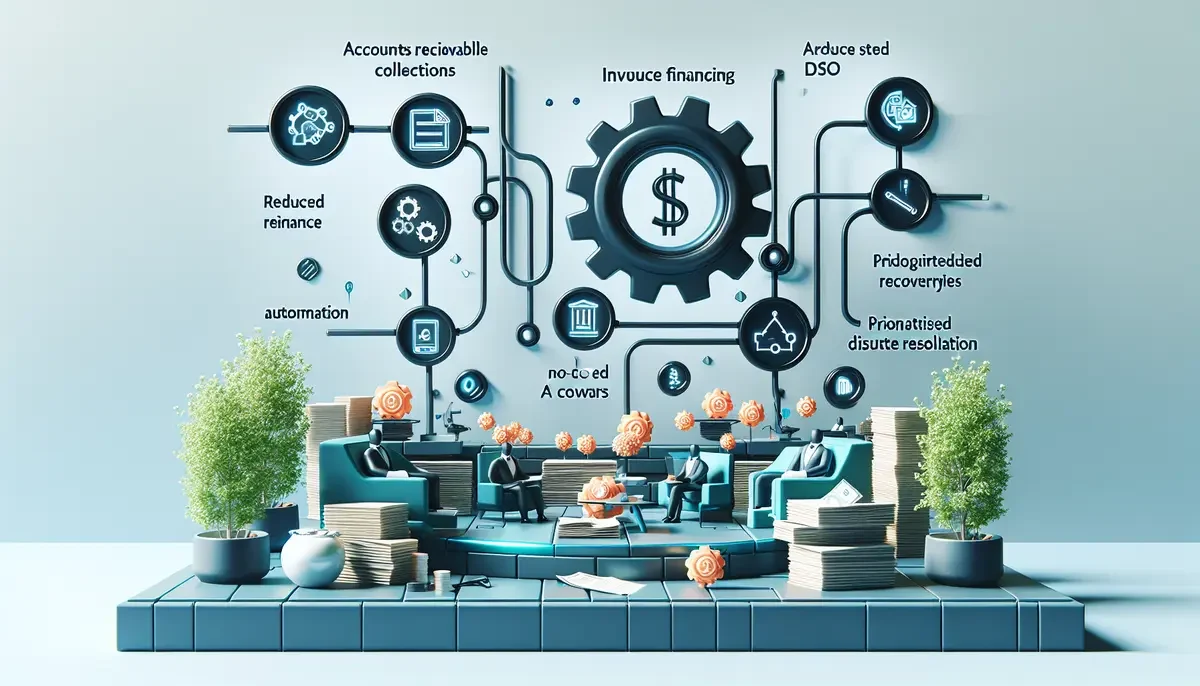
Automating Accounts Receivable Collections for Invoice Financing: No-Code AI Workflows to Reduce DSO, Prioritize Recoveries, and Resolve Disputes
Introduction
Key Takeaways
- Automate AR reminders, tracking, and escalations to reduce DSO and stabilize cash flow.
- Use AI to score risk and prioritize high-impact recoveries for faster collections.
- Centralize dispute intake and resolution with integrated no-code workflows to improve visibility and speed.
Small and medium-sized businesses (SMBs) increasingly rely on invoice financing to maintain liquidity, but manual accounts receivable (AR) collections and dispute resolution processes often lead to delayed payments, higher Days Sales Outstanding (DSO), and strained customer relationships. Recent advances in no-code and AI-powered automation offer SMBs practical, accessible solutions to streamline collections, prioritize recoveries, and resolve disputes efficiently, as outlined in Corcentric’s automated invoice dispute management guide.
This article synthesizes the latest academic, industry, and community insights to identify core pain points faced by SMBs in AR collections for invoice financing and presents actionable, research-backed solutions using no-code AI workflows.
Manual Collections: The Bottleneck in Invoice Financing
Pain Point: Manual AR collection processes are time-consuming, error-prone, and often result in delayed payments, directly impacting cash flow and DSO.
Solution: Implementing no-code automation platforms like Microsoft Power Automate or SaaS AR tools enables SMBs to automate payment reminders, track invoice statuses, and escalate overdue accounts without manual intervention.
For example, a Reddit user on r/automation described using Zapier to trigger automated email reminders and Slack notifications when invoices approach or exceed due dates, reducing manual follow-up and improving on-time payment rates.
Reducing DSO with AI-Powered Prioritization
Pain Point: SMBs often lack the resources to analyze which overdue accounts to prioritize, leading to inefficient recovery efforts and higher DSO.
Solution: AI-driven tools can analyze payment histories, customer risk profiles, and dispute trends to automatically prioritize collections efforts for the highest-impact accounts.
Platforms like Tennis Finance leverage machine learning to flag high-risk invoices and recommend targeted outreach, resulting in up to 50% improved recovery rates and faster cash conversion.
Automating Dispute Intake and Classification
Pain Point: Dispute intake is fragmented across emails, forms, and uploads, making it difficult to track and resolve issues efficiently.
Solution: No-code platforms like Power Automate allow SMBs to centralize dispute submissions from multiple channels—email, web forms, document uploads, and APIs—into a single workflow.
This ensures all disputes are logged, classified, and routed to the appropriate team for resolution, reducing manual sorting and lost cases.
Accelerating Dispute Resolution with AI
Pain Point: Manual dispute resolution is slow, often requiring back-and-forth communication and manual documentation, which delays cash recovery.
Solution: AI-powered platforms can automatically detect, categorize, and assign disputes based on urgency and complexity, enabling faster, more consistent resolutions.
For instance, Tennis Finance reports that automating dispute management can save up to 14 hours per week and significantly improve customer satisfaction.
Workflow Integration: Connecting AR, CRM, and ERP Systems
Pain Point: Disconnected systems create data silos, making it difficult to track invoice status, dispute progress, and customer communications.
Solution: No-code workflow tools like Zapier, Power Automate, and Make (formerly Integromat) can integrate AR, CRM, and ERP platforms, ensuring real-time data synchronization and visibility across teams.
Community discussions highlight how SMBs use these integrations to automate status updates, trigger escalations, and maintain a single source of truth for collections and disputes.
Automated Reminders and Escalations
Pain Point: Missed or inconsistent follow-ups on overdue invoices lead to longer DSO and increased write-offs.
Solution: Automated reminder workflows can send escalating notifications via email, SMS, or messaging apps based on invoice age and customer response.
Some SMBs on r/indiehackers report using templated reminder sequences that escalate from friendly nudges to formal notices, improving collection rates without damaging customer relationships.
Discrepancy Detection and Error Prevention
Pain Point: Invoice errors and discrepancies are a leading cause of disputes and delayed payments.
Solution: AI-powered invoicing software can automatically detect discrepancies, flag potential errors before invoices are sent, and prompt corrective action.
Industry reports note that this proactive approach reduces dispute frequency and accelerates payment cycles.
Centralized Dispute Tracking and Auditability
Pain Point: Tracking disputes across emails and spreadsheets leads to lost cases, compliance risks, and lack of accountability.
Solution: Centralized dispute management modules tie each claim to its invoice, assign ownership, and provide real-time status updates, ensuring transparency and auditability.
Role-based permissions and automated workflows reinforce compliance and streamline collaboration across finance, sales, and customer service teams.
Leveraging Dispute Data for Continuous Improvement
Pain Point: SMBs often fail to analyze dispute trends, missing opportunities to address root causes and improve upstream processes.
Solution: Automated platforms can aggregate dispute data, enabling root cause analysis and process optimization.
By identifying recurring issues, SMBs can adjust billing practices, contract terms, or customer onboarding to prevent future disputes and reduce DSO.
Conclusion
No-code AI workflows are transforming accounts receivable collections for SMBs engaged in invoice financing. By automating manual processes, prioritizing recoveries, and resolving disputes efficiently, SMBs can reduce DSO, improve cash flow, and strengthen customer relationships. The actionable solutions and tools outlined above, grounded in recent research and real-world community experiences, provide a roadmap for SMBs to modernize their AR operations and achieve sustainable growth. Explore more guides on our blog.
Ready to see how AlterFlow AI can transform your workflows?
Book a free consultation today.
References
- [1] Bitcot
- [2] Tennis Finance
- [3] Corcentric
- [4] Meegle
- [5] Bectran
- Reddit: r/automation
- Reddit: r/indiehackers
Related Posts
Building Privacy-Compliant RAG Assistants for Canadian SMBs
Introduction Retrieval-Augmented Generation (RAG) systems combine large language models with your own documents and databases to deliver contextually accurate, grounded answers while minimizing exposu
How to Measure ROI for AI Automation Projects in SMBs
Introduction Small and mid-sized businesses (SMBs) are increasingly turning to AI automation to streamline operations, cut costs, and drive growth. To justify these investments and guide future strate