
CRM vs ERP for distributors: what each one is for, and when your ERP's CRM is enough
For industrial and MRO distributors: which records belong in the ERP and which in a CRM, what the CRM tools inside Prophet 21, NetSuite, Acumatica and Business Central cover according to their own vendors, when that is enough, and how to split the work if you run both.
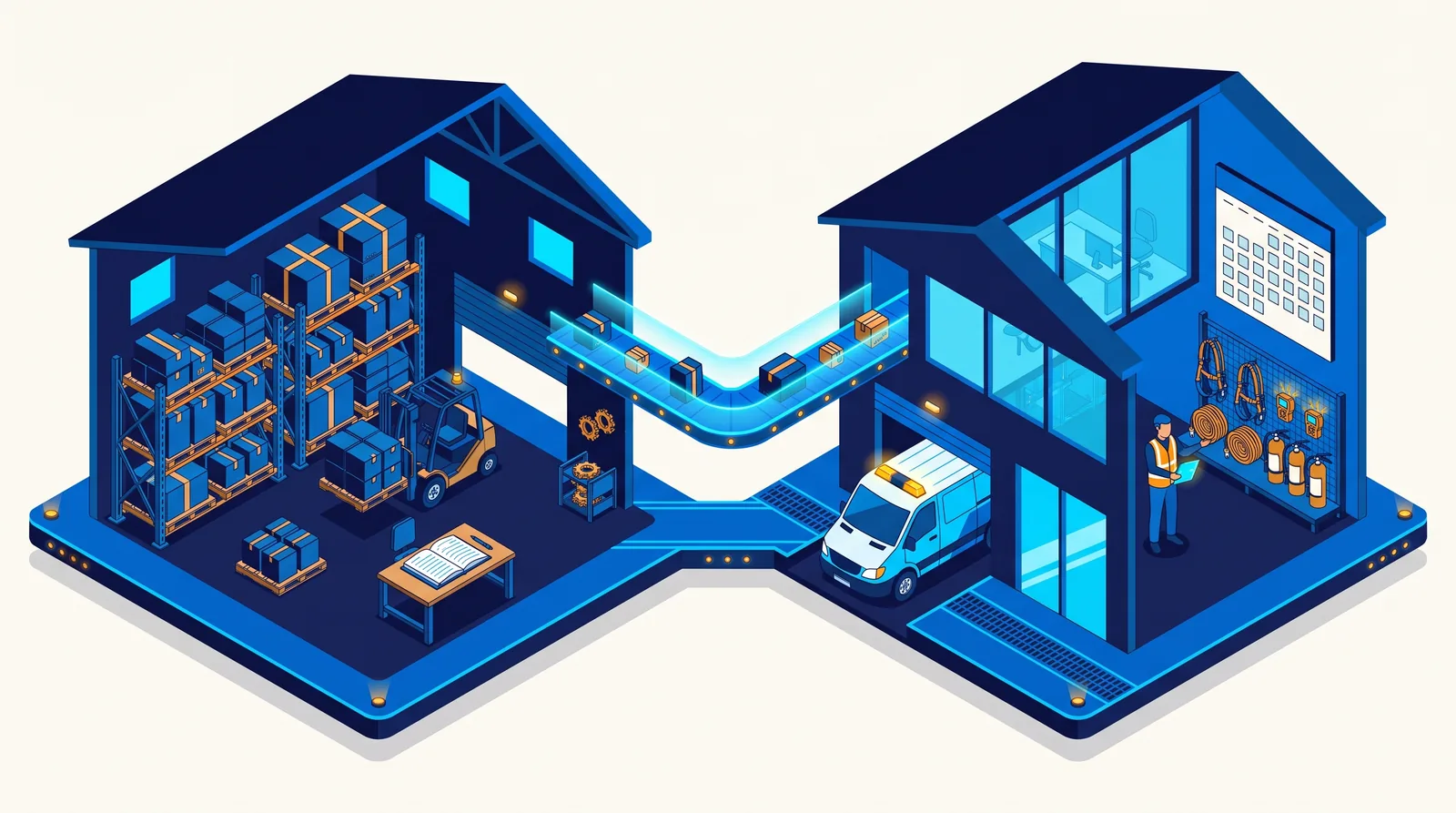
The short answer. CRM vs ERP for distributors comes down to which question each system answers. The ERP answers "what did we sell, at what price, from which stock, and has it been paid?" The CRM answers "who should we call next, why, and what happened the last time?" Many distribution ERPs already include some CRM: Epicor, NetSuite, Acumatica and Microsoft all describe one on their own pages. For a counter-led, order-driven business that is often enough. A separate CRM earns its place when your customers buy by department, when what you sold comes back on a service date, and when your reps own territories and work away from a desk. In that case the ERP stays the system of record, and the CRM sits beside it and never tries to replace it.
Vendor facts in this article were read on the vendors' own pages on October 1, 2026. We build a CRM for industrial & MRO distributors and we do not sell an ERP or an accounting system, so read our view with that in mind.
What lives where: ERP and CRM at a glance
| Record or job | Belongs in the ERP | Belongs in the CRM |
|---|---|---|
| The customer | Legal name, customer number, bill-to and ship-to addresses, credit terms, tax | Who buys inside the account: departments, sites, crews, and the person who signs for each |
| Prices | Price lists, customer contracts, costs and margins | Reads the price it needs; does not own it |
| Stock and purchasing | All of it | None of it |
| Quotes | The priced document, and the order it becomes | What is being pursued, what it is worth, how it ended and why |
| Orders, invoices, payments | All of it | A read-only summary, so a rep knows the history before a visit |
| Visits, calls and notes | Rarely | All of it, including the visits that produced no order |
| The next follow-up | Not its job | Created when an outcome is logged, and visible when it is missed |
| Equipment at the customer | What was sold, the serial number, the warranty; service work if you run a service module | What is coming due, at which department, as a reason to call |
| Who owns the account | Often a salesperson code on the customer | Territory ownership, and which rep can see which book |
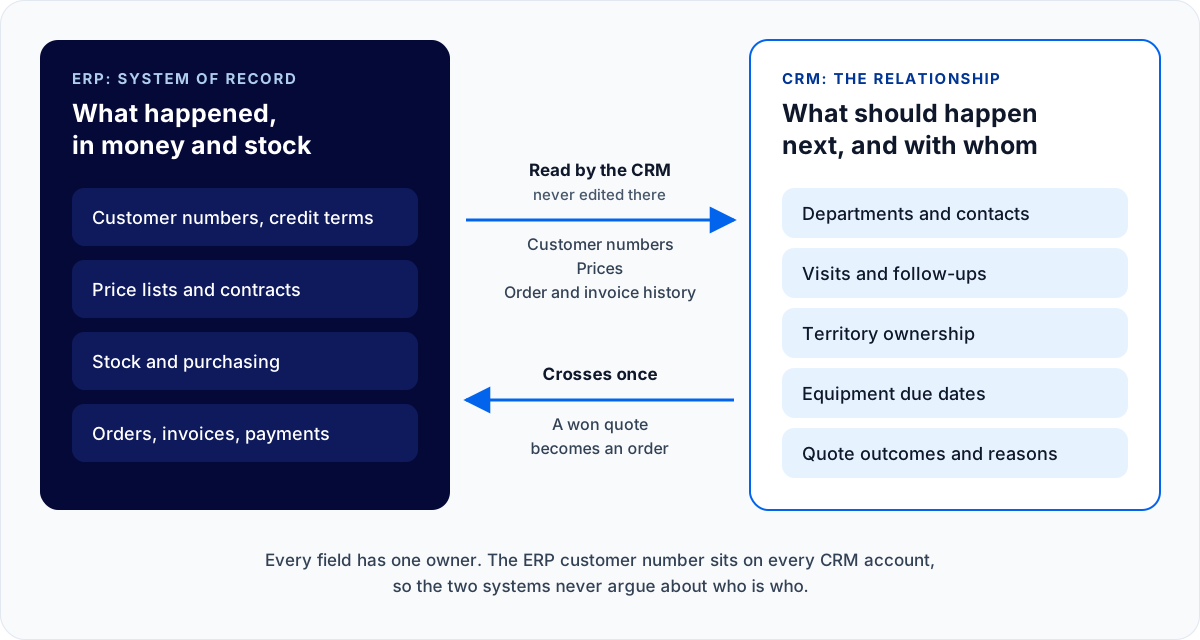
The pattern in the table: the ERP records what happened, in money and stock. The CRM holds what should happen next, and with whom.
Does your ERP already include a CRM?
Probably. Before you price a second system, find out what you already own. This is what four ERP vendors that distributors commonly run say about their own CRM, on their own pages:
| ERP | The CRM the vendor describes | Equipment and service | Worth asking |
|---|---|---|---|
| Epicor Prophet 21 | CRM tools "integrated within Prophet 21", sharing its database: prospect, customer and contact records from opportunity to quote to order, pipeline tracking for managers, call lists and email for marketing | Prophet 21 Service and Maintenance, a module Epicor describes on its own page: service orders, dispatch, preventative maintenance schedules with automated reminders, and warranties tracked by serial number. Epicor suggests pairing it with Epicor Field Service Management when service is a large part of the business | Epicor describes its Mobile Sales app as serving staff "with an internet connection". Ask what a rep can do with no signal |
| Oracle NetSuite | Sales force automation, quotes, forecasts, commissions, support cases and marketing automation in the same system as orders and fulfilment | Field Service Management, with customer assets and preventive maintenance, is "available as an add-on module" | NetSuite says CRM is "included with the NetSuite platform, but additional CRM licenses are needed". Ask what a CRM licence costs per rep |
| Acumatica | "CRM built into Acumatica ERP": leads, opportunities, quotes and sales orders created from opportunities, support cases, and a B2B customer portal | Field Service Management is listed as its own product in Acumatica's modular suite, covering scheduling, dispatch, service orders and recurring maintenance contracts. Acumatica says CRM opportunities can be converted into service orders | Ask which of these your edition and licence include |
| Microsoft Dynamics 365 Business Central | Relationship management features: contacts, interactions, segments, opportunities and campaigns | Service management (service items, contracts, service orders) is available in the Premium experience only | Microsoft's own documentation points to Dynamics 365 Sales for customer engagement. It is a separate Dynamics 365 application; once the integration is set up, default jobs synchronize the two every 30 minutes. Ask whether your reps need it |
None of these four is a customer screen with a notes field. Each is a working CRM for leads and opportunities, tied to quotes and orders, and each has one advantage an outside CRM does not have by design: the quote, the order, the price and the stock level are in one database, with no connector between them.
Where does an ERP's CRM run out for an industrial & MRO distributor?
The CRM inside an ERP is built outward from the transaction. That suits a business whose customer relationship is mostly orders. An industrial or MRO distributor's relationship has more shape than that, and these are the places to test before you decide.
- Departments. A paper mill buys through its maintenance stores, its safety office and its purchasing desk. In an ERP those are often ship-to addresses under one customer. Ask where each one's contact, budget and history live, and whether a rep can read one department's story without reading the whole account.
- Equipment that comes back. The ERP knows the gas detectors were invoiced last spring. Ask what tells a rep, a month ahead, that they are due for calibration. Where the ERP vendors above describe customer equipment, it sits under service and maintenance or field service, which is built for technicians and service orders. Ask whether your sales reps would be licensed for it, and whether a due date there creates a sales follow-up.
- The visit with no order. An ERP's transaction records begin with a quote or an order; a visit that produced neither has to go into its CRM tools. Ask where the Tuesday visit goes when the buyer said "call me after budget", who is reminded, and whether your reps would log it there from the truck.
- The quote that lands in part. You quote a full shutdown list and the customer orders two thirds of it. The ERP has the quote and the order. Ask whether anything ties the two together, and whether anyone records why the rest was lost.
- Territory as ownership. A salesperson code on a customer is a label. Ask whether a second rep can open that account, and through which screens, searches and reports.
- No signal. Reps visit quarries, pump stations and the far end of a plant. Ask what the mobile app does with no connection, and whether a note saved there arrives once.
A vendor who answers all six on your own account, on screen, has a CRM that fits your business, whether it lives inside the ERP or not.
When is the CRM inside your ERP the right choice?
Often. Keep everything in the ERP when:
- Your selling is order-driven. Most revenue arrives at the counter, by phone or through inside sales, and the "relationship" is a history of orders and prices. The ERP already holds it.
- Quotes become orders in minutes. One database means a quote turns into an order without re-keying and without a sync to wait for.
- You have few outside reps, and they visit a small number of accounts they know by heart.
- You already own the licence. Using what you already pay for usually costs less than adding a second system, and there is no connector to buy, map and maintain.
- You run Business Central and want more depth. Microsoft's own route is Dynamics 365 Sales, with an integration Microsoft documents. That is a strong reason to stay with one vendor.
General CRMs such as HubSpot and Zoho sit in the same decision. Their links to distribution ERPs are marketplace apps, a few built by the CRM vendor and most by third parties, which we walked through in our HubSpot vs Zoho comparison for industrial & MRO distributors.
When does a separate CRM earn its place?
When the six tests above matter to how you sell. A distributor with reps on the road, accounts made of departments, and equipment that returns for service, inspection or replacement on a date is running a relationship the transaction does not describe. That is the business a separate CRM is for.
AlterFlow is not the right fit if you want your reps to see live stock and live pricing from the ERP on day one. We have not pre-built a live connector to any ERP: a direct connection is scoped per engagement, and history comes in from exports. The CRM inside your ERP, or a CRM whose marketplace lists a connector for your ERP and version, will get you there sooner. We are also not the right fit if you want a subscription you can start today, or if most of your business is one-off orders with no relationship after the sale.
How should a CRM and an ERP share the work?
If you run both, the arrangement that holds up is the dull one: every field has one owner.
- The ERP owns customer numbers, credit terms, prices, stock, orders, invoices and payments. The CRM reads them and never edits them.
- The CRM owns departments and contacts, visits, follow-ups, territory ownership, equipment due dates and the outcome of every quote.
- A win crosses once. The CRM records what was won; the order is entered in the ERP, by connector where one exists and by hand where it does not. Order and invoice history comes back as a summary a rep can read.
- The customer number is the key. Every CRM account carries its ERP customer number, so the two systems never argue about who is who.
- Start with exports. A nightly or weekly file of customers, price lists and order history proves the split before anyone pays for a live connector.
This is the split we design for. Our CRM page puts it this way: "The CRM holds the quote, its value and its outcome, and hands the rest back rather than trying to replace a finance system mid flight." What exists today, with the same labels we use on our CRM page:
- Departments, equipment at the department, territory ownership, follow-ups created when an outcome is logged, and quotes that record partial wins: Production build, in delivery.
- Getting your data in from exports: running in production today for a dealer in another industry, where we moved a catalogue of roughly seven thousand parts and a decade of sales correspondence in from spreadsheet exports, with column mapping, duplicate handling, a report on every row that failed, and a one-click reversal of the whole import.
- A live connection into an ERP: scoped per engagement. Not something already built and waiting.
- Service and inspection scheduling: In development.
For the full list of questions to put to any vendor, including us, see how to choose a CRM for an industrial or MRO distributor.
Frequently asked questions
Is a CRM part of an ERP? In many distribution ERPs, yes. Epicor describes CRM tools integrated within Prophet 21, Acumatica describes CRM built into its ERP, NetSuite says CRM is included with its platform but needs additional CRM licences, and Business Central has relationship management features. What differs is how far each goes beyond leads, opportunities and quotes.
Can an ERP replace a CRM for a distributor? Our buyer's guide says distributors usually need a CRM beside the ERP's transactions; that CRM can be the one inside the ERP. For an order-driven distributor with simple accounts, it can be all you need. For one whose customers are departments with equipment on service dates and reps who own territories, test the six points above on your own account before deciding.
Does Prophet 21 have a CRM? Yes. Epicor's Prophet 21 CRM page describes tools that share the Prophet 21 database and cover prospects, customers and contacts from opportunity to quote to order, with pipeline tracking and a Mobile Sales app.
Do we need Dynamics 365 Sales if we already run Business Central? Not always. Business Central has contacts, interactions, opportunities and campaigns. Microsoft positions Dynamics 365 Sales for customer engagement and documents an integration that synchronizes customers, contacts, prices and sales orders between the two.
Should quotes live in the CRM or the ERP? The priced document belongs where your prices are, which is usually the ERP. The CRM should hold what was pursued, what it was worth, what was ordered and why the rest was lost. Without that, the pipeline shows wins and hides the gaps.
Will a CRM beside our ERP mean entering customers twice? It should not. Customers and prices come from the ERP, by connector or by export, and each record has one owner. If a vendor's plan has your reps re-keying customers and prices the ERP already holds, the split is wrong.
See the CRM side on screen. The working demo is open with no form and no sign-up: a prototype on sample records that shows departments inside an account, equipment with a service due date at the department, and a won deal that records the value actually ordered and the reason it came in below the quote. Or book a walkthrough and bring your messiest account.
Sources, read October 1, 2026: Epicor Prophet 21 CRM, Prophet 21 Service and Maintenance. Oracle NetSuite CRM, Field Service Management. Acumatica CRM, Field Service Management. Microsoft Business Central relationship management, integration with Dynamics 365 Sales, service management. Features, editions and licensing change; check the vendor's page before you buy.
Related Posts
How to choose a CRM for an industrial or MRO distributor: the questions to ask before you sign
What an industrial or MRO distributor should ask every CRM vendor, grouped by the way your business works: customers with departments, equipment on dates, territories, quotes, your ERP, access and ownership. Plus the red flags in a demo and the costs outside the licence.
HubSpot vs Zoho for industrial & MRO distributors: what each one takes to fit (2026)
A side-by-side for industrial and MRO distributors: how HubSpot and Zoho handle departments inside a customer, equipment on a service date, territories, quotes and your ERP, what 10 reps cost in year one, and a 30-minute test to run on any CRM.