
Salesforce for distributors: what Field Service, CPQ and territories add up to
For industrial & MRO distributors: which Sales Cloud edition includes territories, quotes and offline use, what Salesforce's own pages charge for Field Service and Revenue Cloud (its CPQ), what the sum leaves out, and a worked list-price example for a 12-rep distributor with a small service team.
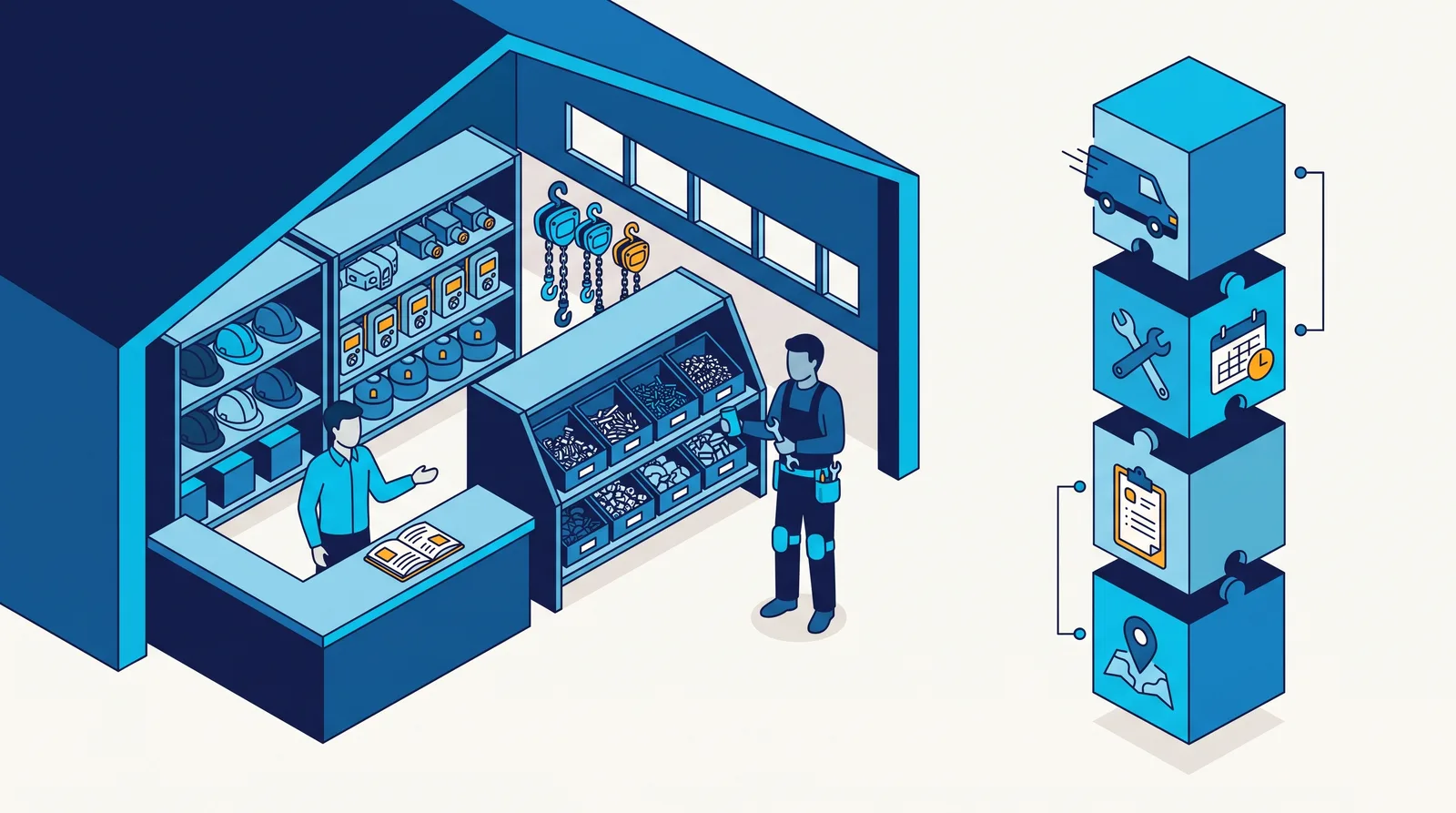
The short answer. Salesforce for distributors works as a stack of separately priced products: it can do what an industrial or MRO distributor needs, one product at a time. On Salesforce's own pricing pages, read on October 12, 2026: territories start at the Sales Cloud Core edition (US$195 per user per month). Configure-price-quote is Revenue Cloud, a paid add-on listed at US$150 per user per month for its Growth edition. Maintenance schedules for customer equipment are documented under Field Service, at US$175 per user per month for a dispatcher or a technician. Every one of those prices is billed annually. For a distributor with 12 outside reps, one dispatcher and three technicians, the prices Salesforce publishes add up to US$60,420 a year at list.
That is list price, before any discount, tax, partner fees or optional add-ons. The rest of this article shows where each number comes from, what is missing from the sum, and when Salesforce is the right call anyway.
We build a CRM for industrial & MRO distributors, so read our view with that in mind. Every Salesforce fact below is from Salesforce's own pages, linked at the end.
Which Sales Cloud edition does a distributor need?
Salesforce's Sales pricing page lists five paid editions. Its comparison table shows which edition includes each feature. These are the rows that matter most to a distributor's field sales team.
| What a distributor asks for | Starter Suite | Pro Suite | Core | Advanced | Max |
|---|---|---|---|---|---|
| Price, US$ per user per month | $25 | $100 | $195 | $395 | $550 |
| Billing | Monthly or annually | Annually | Annually | Annually | Annually |
| Accounts, contacts, leads, opportunities | Included | Included | Included | Included | Included |
| Products and price books | Included | Included | Included | Included | Included |
| Quotes, orders, contracts | Not included | Included | Included | Included | Included |
| Full offline mobile functionality | Not included | Included | Included | Included | Included |
| Sales Territories | Not included | Not included | Included | Included | Included |
| Approval processes | Not included | Not included | Included | Included | Included |
| Flow Builder (automation) | Not included | 5 flows per org | Included | Included | Included |
| Web Services API | Not included | "Additional $25 USD/user/month" | Included | Included | Included |
| Roles and permissions | Included | Included | Included | Included | Included |
| Premier Success Plan | Not included | Available for purchase | Included | Included | Included |
| "Sales Planning, Sales Programs, Incentive Compensation Management, Maps Advanced" | Available for purchase | Available for purchase | Available for purchase | "Sales Programs" | "All included" |
Source: salesforce.com/sales/pricing, read October 12, 2026. Salesforce also lists a Free Suite, left out here.
Three things stand out for a distributor.
Territories point to Core. The feature Salesforce calls Sales Territories, with a territory model and account assignment rules, starts at Core, at US$195 per user per month. There is a second route to check first: the same table lists "Roles and Permissions" in every edition, described as "Establish roles and permissions that set object/data access for different users." Ask Salesforce whether roles and permissions alone would keep each rep to their own book on Starter Suite or Pro Suite, and what you give up without the territory model.
The API row matters if you run an ERP. Salesforce describes that row as "Connect external systems and data to Salesforce using web service APIs, including REST, SOAP, and more." On Pro Suite the Web Services API is listed as an additional US$25 per user per month. On Core and above it is included.
The quote in the table is the basic one. Salesforce describes the Quotes row as "Easily create basic quotes by pulling in products and pricing to show customers." Standard approval processes are included from Core. Product configuration, pricing rules and what Salesforce calls Advanced Approvals are in a separate product, covered next.
One naming point. Salesforce announced the Core, Advanced and Max editions on September 3, 2026. Its help pages and the notes on its add-on pricing pages still say Enterprise and Unlimited. The Sales Territories help page, for example, lists the feature as available in "Performance and Developer Editions and in Enterprise and Unlimited Editions with Sales". Salesforce's add-ons page pairs the names as "Enterprise/Core" and "Unlimited/Advanced", and the announcement says Max keeps the price of the Agentforce 1 Edition. It also says "Existing customer pricing on legacy editions remains unchanged", so a company already on Salesforce may be paying different numbers from the ones in this article.
What does Salesforce CPQ cost on top?
Salesforce now sells configure-price-quote as part of Revenue Cloud. Its Revenue Cloud pricing page says so directly: "Yes, Revenue Cloud includes CPQ (Configure, Price, Quote) features." It also answers the question a buyer cares about: "No, Revenue Cloud is a paid add-on. It is a separate product that you purchase in addition to your standard Sales Cloud subscription."
| Revenue Cloud edition | Price stated | What the page lists |
|---|---|---|
| Growth | US$150 per user per month, billed annually | Product catalog and price management, product configurator, price and quote, order management, subscription and asset lifecycle, advanced approvals, document generation, usage selling. Contract lifecycle management is "Available for purchase" |
| Advanced | US$200 per user per month, billed annually | Everything in Growth, plus contract lifecycle management and Revenue Management Intelligence. Invoice management is listed as "Available for purchase" |
Two details. The Revenue Cloud card on the Sales pricing page says "From $200 USD/user/month", while the Revenue Cloud pricing page and the add-ons page both list Growth at US$150, so confirm which applies to you. And the add-ons page lists Revenue Cloud for Enterprise/Core and above, not for Pro Suite.
Does a distributor need it? It depends on who writes your quotes and how complicated they are. If inside sales writes quotes in the ERP, as we described in CRM vs ERP for distributors, the basic Quotes feature in Pro Suite and above may be enough to record the quote and its outcome. If reps build quotes with customer-specific pricing rules, kits and approval chains inside the CRM, that is what Revenue Cloud is sold for. Ask Salesforce or a partner to quote your three hardest quotes both ways.
One test to bring: a quote where the customer ordered less than you quoted. Ask where the shortfall and the reason are recorded, and which product you need for that.
What does Field Service add, and what does it cost?
In our view, for an industrial or MRO distributor the equipment already on the customer's floor is often the next sale: the gas detector due for calibration, the harness due for inspection, the extinguisher due for recertification.
Salesforce has a record for this, called an Asset. Its help page says "assets represent the specific products your customers have purchased" and that "Assets have a serial number, purchase date, and other information related to an individual sale." The schedule comes from maintenance plans: "With maintenance plans you define how often maintenance visits occur and generate work orders for future visits."
Both of those help pages sit in Salesforce's Field Service documentation, which says the Field Service core features "are available in Enterprise, Unlimited, and Developer Editions."
Field Service is not the only place Salesforce lists equipment records. Its Service pricing page marks "Asset Management and Product Tracking" and "Work Order Management" as included in Service Cloud Core (US$195 per user per month, billed annually), Advanced and Max, and not in Starter Suite or Pro Suite. Revenue Cloud lists "Subscription & Asset Lifecycle" in both of its editions. The Sales pricing page does not mention assets, and we did not find a Salesforce page that says whether a rep on a Sales Cloud licence alone can see the Asset record. So ask two questions. Which licence does a sales rep need to see a customer's equipment and its due dates? And if you only need a reminder before a due date, with no dispatching, can it be done with the Asset record and an automated flow, with no Field Service licence? Flow Builder is in the table above. Ask to see it working on your edition before you assume either answer.
Here is what Salesforce's Field Service pricing page states.
| Field Service licence | Price stated (US$, billed annually) | For |
|---|---|---|
| Dispatcher | $175 per user per month | The person who schedules and assigns the work |
| Technician | $175 per user per month | The mobile app for the person doing the work, with offline access |
| Contractor Plus | "$80 user/month or $32/login" | Outside contractors |
| Field Service Plus | $230 per user per month | "Combine the power of Dispatcher, Technician, Service Cloud and Sales Cloud" |
| Agentforce 1 Field Service | $650 per user per month | Field Service Plus with Salesforce's full AI suite |
The notes under that table are worth reading in full. Five of them matter here:
- "All per user products require an annual contract."
- "Above pricing available on Enterprise Edition. Unlimited Edition versions of Dispatcher and Technician are $330/user/month and Field Service and Operations Plus is $380."
- Field Service "requires at least one (1) Service Cloud user license", which the Field Service Plus bundle can also satisfy.
- Technicians and contractors "require at least one (1) Dispatcher in order to use the scheduling tool."
- "Dispatcher and Technician licenses may not be used for a contact center, call center, or customer case management application."
Work order management, asset management, service contract management and appointment booking are marked as included in all five licences in the comparison table. Some items are listed as "Available for Purchase" on top, such as the asset coverage view and work order estimation.
What does it add up to for a 12-rep distributor?
Take a distributor with 12 outside reps who need territories and configured quotes, plus a small service team of one dispatcher and three technicians who look after customer equipment. Using only prices published on Salesforce's own pages:
| Line | Calculation | US$ per year, list |
|---|---|---|
| Sales Cloud Core, 12 reps | 12 × $195 × 12 months | $28,080 |
| Revenue Cloud Growth, 12 reps | 12 × $150 × 12 months | $21,600 |
| Field Service Dispatcher, 1 | 1 × $175 × 12 months | $2,100 |
| Field Service Technician, 3 | 3 × $175 × 12 months | $6,300 |
| Service Cloud Core, 1 (Field Service requires at least one Service Cloud licence) | 1 × $195 × 12 months | $2,340 |
| Published list prices, total | $60,420 |
That is the arithmetic on published list prices, in US dollars, and it is not a quote. Read it with what it leaves out:
- Salesforce Maps and Sales Planning, if you want location-based tools and territory design. Salesforce's add-ons page lists Sales Planning at "$75/user/month" and Salesforce Maps "Starting at $75/user/month", billed annually. For 12 reps that is US$10,800 a year for Sales Planning, and from US$10,800 for Maps, at list.
- Success Plans. The Sales and Service pricing tables mark the Premier Success Plan as included from Core. The Revenue Cloud and Field Service pricing pages list Premier at "30% of net license fees" and do not say whether the Core bundle covers those licences, so ask. The Signature plan is "Contact your account executive". We covered the plans in why CRM rollouts fail at distributors.
- The implementation. Someone has to design your accounts, territories, price rules and maintenance plans inside these products. Salesforce's pricing pages point to its Professional Services and certified partners for that, and we have no published figure to give you for it.
- A different way to licence the service team. The Field Service notes say the Service Cloud requirement "can also be met with" the Field Service Plus bundle at US$230. Ask Salesforce which combination is cheaper for your team.
- The ERP connection. Salesforce's pricing FAQ says that where there is no built-in integration, "you can purchase licenses of MuleSoft, work with our integration partners, or use apps on AgentExchange."
- Inside sales, managers and counter staff who also need a login.
- Negotiated discounts and tax. Salesforce's pages say the prices are for information and to contact a sales representative for detailed pricing.
Leave out Revenue Cloud and the same team is US$38,820 a year at list. Leave out the service team as well and 12 reps on Core are US$28,080. This example uses a different team from the 10-rep example in HubSpot vs Zoho for industrial & MRO distributors, so the two totals are not comparable. The point of the exercise is to know which lines you are buying and why, so the first quote you get does not surprise you.
Does Salesforce have a product built for distributors?
It has a page with that name. "Salesforce for Distributors" sits in the Consumer Goods section of salesforce.com, and it is written for distributors of consumer goods. It talks about retail execution, "store-level insights" and identifying "planogram gaps and out-of-stocks", and it builds the solution from Consumer Goods Cloud, Commerce Cloud, Order Management and Omnistudio. The customer quoted on the page is Southern Glazer's.
The page also has a section on B2B purchasing, with "pre-negotiated pricing" and "One-click reordering", which is not only about retail. But if you sell safety equipment, fasteners or lifting gear to plants, mines and municipalities, most of that page is about a different trade. We did not find an equivalent Salesforce page for industrial distribution. The closest industry product we found is Manufacturing Cloud, whose Sales Core edition is listed at US$275 per user per month, billed annually, and describes "opportunities, run-rate agreements, demand forecasts, and projects". Its pricing FAQ says Sales Cloud is included in Manufacturing Cloud for Sales. Salesforce's September 3 announcement says new pricing for its industry editions "will go into effect later this fall", so that price may change. Whether its run-rate agreements fit your blanket orders is worth a demo if a large share of your revenue is repeat supply.
So, as we read Salesforce's pages, an industrial or MRO distributor on Salesforce is assembling: Sales Cloud for the reps, Revenue Cloud if quotes are complex, Field Service or Service Cloud if equipment and service dates matter. Each piece is documented and priced in public. You or your partner do the assembly.
When is Salesforce the better choice for a distributor?
In our view, in these cases:
- You have a Salesforce administrator or a partner you trust. The products above are configured, not coded from nothing, and Salesforce's own pricing pages point buyers to its Professional Services and certified partners for that work.
- You run a real service operation. If you dispatch technicians daily, Field Service gives you scheduling, a dispatcher console, a technician app with offline access, service contracts and maintenance plans as documented, priced products.
- You are large or growing by acquisition. Many branches and business units need one reporting line, and Salesforce has higher editions to grow into. We covered the account structure side in account hierarchy in a CRM for distributors.
- You want published prices. Everything in the tables above is on a public page. You can budget before the first sales call.
- You need apps and integrations from a marketplace. Salesforce points to AgentExchange, its marketplace of partner apps, for integrations it does not build itself.
AlterFlow is not the right fit if you want to sign up online and start the same day, you want a per-seat list price to compare line by line with the tables above, or you need a certified partner network and a marketplace of apps. We publish none of those. We are also not a fit if you need technician dispatch today: our service and inspection module is labelled In development and is not something you can use yet.
How does AlterFlow approach the same needs?
We make a different trade. Where Salesforce offers broad products you assemble and configure, our industrial & MRO CRM is one system shaped around a distributor's structure. It is quoted on scope, not per seat, so we have no list price to put beside the tables above, and you should weigh that against Salesforce's published numbers. Your data stays yours.
Here is where each need in this article stands with us, with the status label our own product page carries. Production build, in delivery means built and being deployed to a live team, not a product with a long customer list.
| Need | In AlterFlow | Status |
|---|---|---|
| Territories and per-rep books | Territory ownership and per-rep books, with isolation between them enforced in the database | Production build, in delivery |
| Quotes | Quote records with partial wins captured against what was ordered, and the reason for the gap. In our builds, quoting and invoicing stay where they already are. We do not offer configure-price-quote | Production build, in delivery |
| Customer equipment and due dates | Equipment held at the department that owns it, carrying its own service cadence | Production build, in delivery |
| No signal in the field | Capture that holds on the device and arrives exactly once | Production build, in delivery |
| Technician dispatch, inspection forms, certificates | Service, inspection and maintenance module | In development |
| Live connection into a legacy inventory platform | Work we scope per engagement | No label: not already built |
Two honest limits. Assigning a new lead to a territory automatically is something we build as part of an engagement, not a switch that is already wired in. And if dispatch is what you need this year, the Field Service section above describes a product you can buy today, and ours is not.
Frequently asked questions
Is Salesforce good for distributors? It can be. Salesforce covers territories, quoting and customer equipment through Sales Cloud, Revenue Cloud and Field Service. The work is in choosing the editions and add-ons and configuring them for a distributor's accounts. Salesforce's pricing pages point to its Professional Services and certified partners for that. Its page titled "Salesforce for Distributors" is written for consumer goods distribution.
Which Salesforce edition includes territory management? On Salesforce's Sales pricing page, read October 12, 2026, Sales Territories is included in Core (US$195 per user per month, billed annually), Advanced and Max, and not in Starter Suite or Pro Suite. The help page lists it for Enterprise and Unlimited Editions with Sales, and for Performance and Developer Editions.
Is CPQ included in Sales Cloud? Basic quotes are included from Pro Suite. Configure-price-quote is part of Revenue Cloud, which Salesforce's Revenue Cloud pricing page calls "a paid add-on" bought in addition to Sales Cloud: US$150 per user per month for Growth and US$200 for Advanced, billed annually.
How much does Salesforce Field Service cost? Salesforce lists Dispatcher and Technician licences at US$175 per user per month each, and Field Service Plus at US$230, billed annually, on Enterprise Edition. The same page gives higher prices for Unlimited Edition and requires at least one Service Cloud licence and at least one Dispatcher.
Can Salesforce track customer equipment and service dates? Yes. Salesforce documents an Asset record with a serial number and purchase date, and maintenance plans that generate work orders for future visits. Maintenance plans are documented under Field Service. Asset management is also listed in Service Cloud Core and above, and asset lifecycle in Revenue Cloud. Ask Salesforce which licence your reps need to see the record, and whether an automated reminder meets your need without Field Service.
What is not included in Salesforce's published prices? Implementation by a partner or your own administrator, the ERP connection, negotiated discounts and tax. Optional add-ons are priced separately, such as Sales Planning and Salesforce Maps from US$75 per user per month each. Salesforce's pages also say to contact a sales representative for detailed pricing.
See the structure before you price a stack. The working demo is open with no form and no sign-up: a prototype on sample records. Open a customer to see its departments, the equipment on a department with a service due date, and a won deal that records a partial win and the reason. On a desktop browser, switch between reps to see each one's own book, as the prototype's interface shows it. Or book a walkthrough and bring the Salesforce quote you were given.
Sources, read October 12, 2026, all Salesforce's own pages: Sales pricing, Sales add-ons, Service pricing, new editions announcement (September 3, 2026), Revenue Cloud pricing, CPQ, Field Service and Operations pricing, Manufacturing Cloud pricing, Salesforce for Distributors. Help pages: Sales Territories, Set up assets, Set up Field Service maintenance plans. The pricing and help pages show no "last updated" date. Prices are US dollars as the pages state them, before tax. Prices, editions and features change; check the vendor's page before you buy.
Related Posts
Why CRM rollouts fail at distributors, and what to do differently
For industrial & MRO distributors: what the published CRM failure rates measured, six reasons a rollout stalls after go-live, the early sign of each, what five CRM vendors say about adoption and onboarding on their own pages, and a 90-day plan with five numbers to watch.
Account hierarchy in a CRM for distributors: parent accounts, departments or ship-to addresses?
For industrial & MRO distributors: the four ways a CRM can hold a customer that buys through several sites and departments, the five decisions to make before you build the structure, and what five CRM vendors say about account hierarchy on their own pages.